
- Homepage
- Character
- Industry
- Language
- Movie
- Barbershop (14)
- Barbie (5)
- Candyman (5)
- Ghostbusters (7)
- Goodfellas (10)
- Halloween (5)
- Harry Potter (5)
- Interstellar (10)
- Jurassic Park (13)
- Movie (11)
- Pulp Fiction (8)
- Rounders (7)
- Saw (6)
- Scarface (5)
- Scream (7)
- Star Wars (6)
- The Dark Knight (7)
- The Exorcist (5)
- The Godfather (9)
- Toy Story (5)
- ... (5311)
- Object Type
- Signed By
- Adam Sandler (16)
- Al Pacino (8)
- Ben Stiller (8)
- Christian Bale (20)
- Dan Aykroyd (8)
- Daniel Radcliffe (10)
- Greta Gerwig (6)
- Hans Zimmer (6)
- Jeff Goldblum (5)
- Jerry Bruckheimer (6)
- John Travolta (5)
- Kevin Smith (9)
- M. Night Shyamalan (5)
- Martin Scorsese (14)
- Matt Damon (21)
- Quentin Tarantino (10)
- Robert Zemeckis (7)
- Sam Raimi (6)
- Tim Allen (7)
- Whoopi Goldberg (6)
- ... (5278)
RAPPACCINI'S DAUGHTER (1944) Selznick Development Nathaniel Hawthorne Story+COA
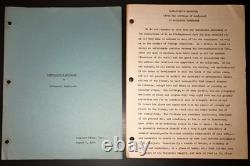
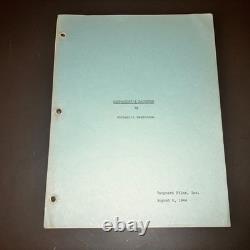
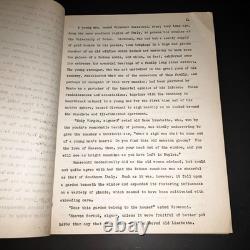
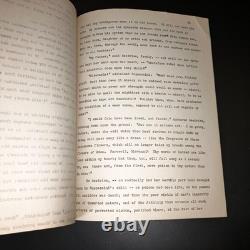
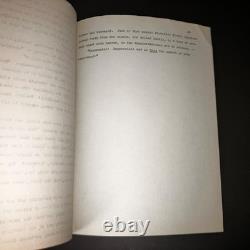


RAPPACCINI'S DAUGHTER (1944) Selznick Development Nathaniel Hawthorne Story+COA! Guaranteed Vintage and Original as issued. Comes with COA from the Museum of Mom and Pop Culture! Not signed or noted, but this important script was David O.
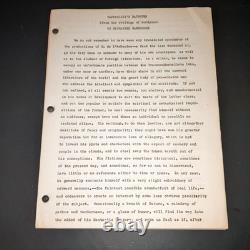
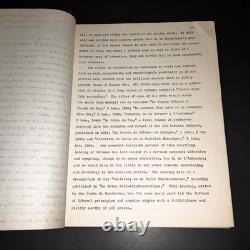
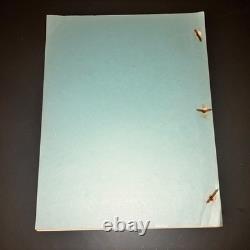
Selznick's personal copy and was deaccessioned from the Selznick Archive by the Harry Ransom Center at the University of Texas in Austin. Here's a terrific piece. Selznick's / Vanguard Films, Inc. Treatment for the development of a feature film based on Nathaniel Hawthorne's 1844 Gothic Horror Short Story. Covers - 39 White Pages - Page 1 and 2 assess the property and marketplace and on Page 3-39, you find the full short story.
Looks like the full cover is a hand-typed original. Selznick did not make the film, but the story is classic! OVERALL CONDITION: See Photos - Fine to Very Fine - Cover is loose (Cover has slipped off its brads) - You won't be disappointed in this fantastic piece. "Rappaccini's Daughter" is a Gothic short story by Nathaniel Hawthorne first published in the December 1844 issue of The United States Magazine and Democratic Review in New York, and later in various collections.
It is about Giacomo Rappaccini, a medical researcher in Padua who grows a garden of poisonous plants. He brings up his daughter to tend the plants, and she becomes resistant to the poisons, but in the process she herself becomes poisonous to others. The traditional story of a poisonous maiden has been traced back to India, and Hawthorne's version has been adopted in contemporary works. Selznick's involvement with Rappaccini's Daughter is one of the better-known unrealized prestige projects of classic Hollywood-ambitious, much discussed in memos, but never produced. Selznick acquired the screen rights to Nathaniel Hawthorne's 1844 short story in the mid-to-late 1940s.
He viewed it as a serious literary prestige film, in line with his post-Gone with the Wind ambition to elevate Hollywood adaptations of classic literature. The material appealed to him for its. Potential for lush visual symbolism (especially color). Selznick envisioned the film as. Highly stylized, possibly in Technicolor.
More romantic and tragic than overtly horrific. The danger of "playing God". He was particularly interested in translating the poison/flower imagery into color symbolism-something he believed only a top-tier production could achieve. The project was widely discussed internally as a star vehicle, most often associated with Jennifer Jones, Selznick's protégée and wife at the time. Multiple writers were reportedly considered or commissioned for treatments and drafts, though no definitive screenplay was ever finalized. How faithful to remain to Hawthorne's ambiguity. How to soften the bleakness for mainstream audiences. Avoiding censorship problems under the Production Code (sexual symbolism, bodily corruption, moral pessimism). Why the Film Was Never Made. The story's short length and symbolic density made expansion risky. Selznick worried about turning it into either.A dull "literary talk piece, " or. Themes of eroticized danger, contamination, and toxic femininity raised red flags. Selznick anticipated heavy resistance from the PCA. By the late 1940s, Selznick International Pictures had effectively dissolved. Selznick shifted toward independent producing, focusing on projects with clearer commercial prospects.
As with several Selznick projects, his dissatisfaction with scripts and tone led to repeated delays-until momentum was lost. Selznick's version of Rappaccini's Daughter remained unproduced. The story would later be adapted in other forms. Daniel Catán's 1991 opera.Various low-budget or experimental film adaptations. None followed Selznick's grand, Technicolor prestige vision. SEE MORE CLASSIC PLAYS, MUSICALS AND SCREENPLAYS FROM THIS AMAZING 150K SCRIPT ARCHIVE IN OUR OTHER AUCTIONS - AND IN THE WEEKS TO COME! If it is a birthday or emergency, we can make special arrangements. We love to combine, but if you win more than one item, wait for us to pack and weigh your total order and invoice you for that total.
We use UPS for higher-grade material.